
The Hidden Passenger in your weekly food shop
How much was your last water bill?
Try to remember the number — in pounds, in euros, in dollars. Most of us can manage a vague guess. Almost none of us can tell you how many litres it bought.
Now try a harder question: how much water did you consume last week through your food?
Not the glass by your bed. The water used to grow and process your morning coffee, your lunchtime salad or the punnet of raspberries you grabbed on the way home. The hidden water — what hydrologists call your water footprint — is somewhere between 50 and 100 times larger than the water you use from your tap (Hoekstra, 2020).
The flow of this hidden water moves unevenly across borders. In many high high-income countries as much as 40–80 per cent of their water footprints are external, meaning they are highly reliant on water use elsewhere.
And almost all of it is coming from places you've never been and from aquifers you'll never see where other communities and ecosystems depend on it.
A problem with no postcode
The challenges posed by this external water use are significant. Produce regions face increased risks of water scarcity, pollution, ecosystem degradation, and heightened climate vulnerability. You might assume the worst-hit places are the already dry ones — the deserts, the drought belts, the countries where the rivers run thin on the news. But the geography and patterns of water stress is not so straight forward. Take two countries that, on paper, could not be less alike.
Indonesia is the world's largest archipelago — seventeen thousand islands scattered across the equator,drenched by monsoons, ringed by ocean, the very picture of abundance with one of the highest rainfalls in the world. And yet Indonesia's problem is not the rain — it is the clock and the calendar: the monsoon season floods the country for months, then vanishes, and the infrastructure to bank that abundance for the dry season is not enough at the scale the islands required (World Bank, 2024).
Morocco sits at the other end of the spectrum: a kingdom whose southern half dissolves into the Sahara, the largest hot desert on Earth, where rain is a rumour for months at a time (World Bank, 2024).One country is surrounded by water. The other is surrounded by sand.
Yet both are facing a water crisis.
The underlying story is the same.
From the Cape vineyards of South Africa to the avocado fields of Michoacán, from the cut-flower farms of Lake Naivasha to the strawberry tunnels of Huelva, a strikingly similar pattern keeps repeating itself. Global consumption demands are deepening water stress.
When the value of water is not reflected in global trade and pricing, consumption needs will continue to drive water-intensive activities in water-stressed regions. The costs of communities and ecosystems will remain hidden.
So let's zoom in on one of these stories — not because it is the worst, but because it is one of the clearest.
A policy triumph, photographed from above
Fly over the Souss-Massa plain in southern Morocco and the landscape glints back at you. Mile after mile of greenhouses stretch toward the snow-capped Atlas Mountains, a silver sea of polythene and steel. Inside, drip lines whisper water onto the roots of tomatoes, blueberries, and raspberries that — within 48 hours — will be sitting on a shelf in Tesco, Carrefour, or Lidl.
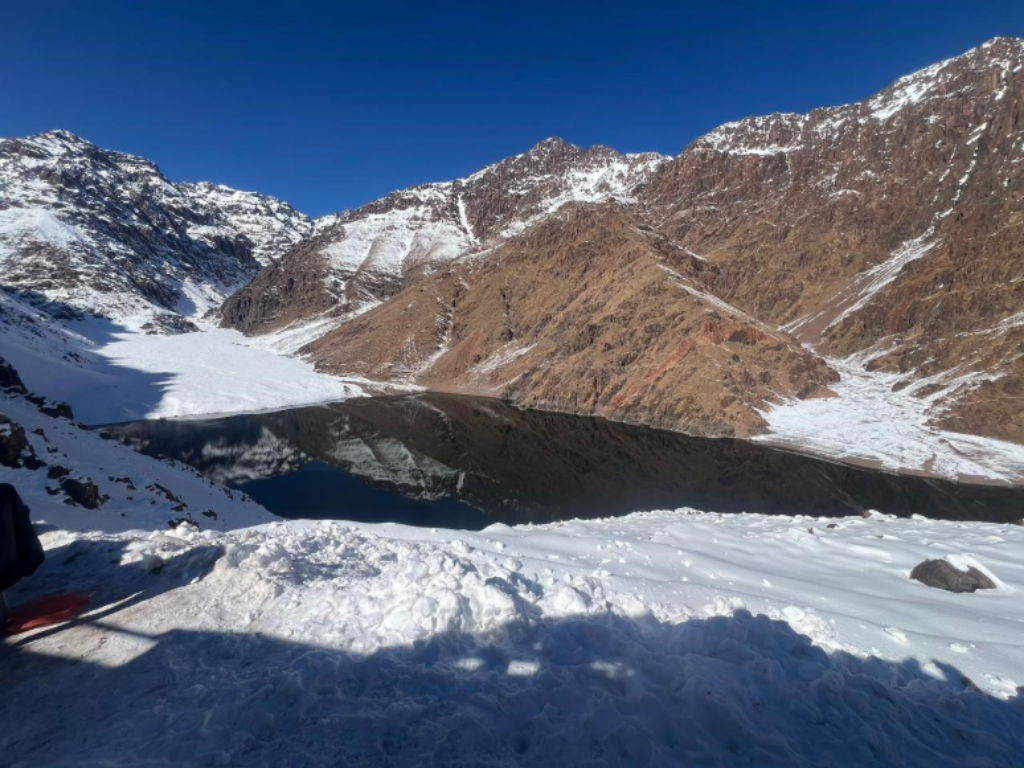
Image 1: The Atlas Mountains are the main water supplier of groundwater in Souss Massa
This didn't happen by accident. It is the deliberate, patient achievement of two decades of Moroccan strategy: the Green Morocco Plan (2008–2020) and now the Green Generation Strategy (2020–2030). Together they have transformed Morocco into one of the world's most sophisticated fresh-produce exporters. Rural incomes have risen. Exports have grown fivefold since the EU–Morocco trade agreement. A whole generation of agribusiness entrepreneurs has built world-class operations on what was, not so long ago, marginal land.
By almost any conventional measure, this is what success looks like.
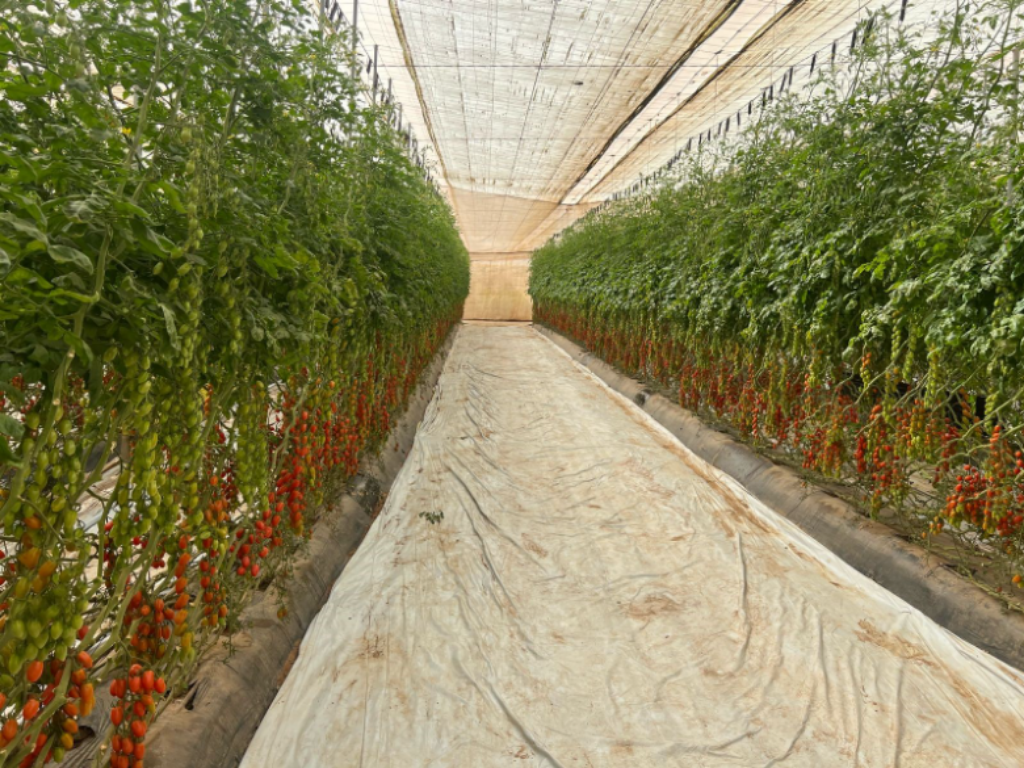
Image 2: Tomatoes grown in a greenhouse in Sous-Massa.
But every tomato, every berry, every neatly-packed punnet, carries an invisible passenger - water.
Groundwater overexploitation
Here is the number that should stop you mid-sentence:
The Souss-Massa aquifers are being extracted at roughly 164 % of its natural recharge rate.
In plain English: for every litre that rain and Atlas snowmelt put back into the ground, farmers and exporters are pulling out more than one and a half. In some sub-basins, the water table is dropping by more than a metre every single year.
Now layer climate change on top. Rainfall in the basin is projected to fall by 10 to 30 % in the coming decades, driven by the global north emissions. The mountains that feed the system are losing their snow. The recharge side of the equation — the side we cannot negotiate with — is shrinking.
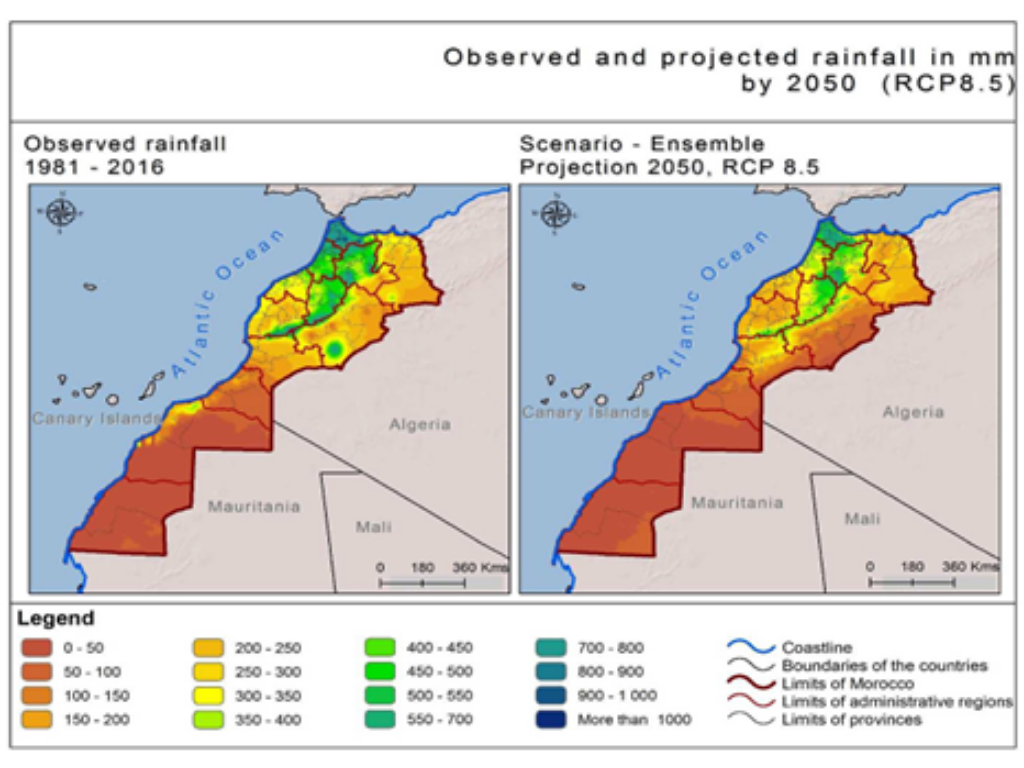
Figure 1: Maps of observed and projected rainfall by 2050, RCP 8.5 (EZZINE, 2018)
Before going further
Morocco has not been asleep at the wheel by the way:
By early 2025, Morocco had built 154 large dams storing 20.7 billion cubic metres, irrigating 1.4 million hectares
It’s Programme National d'Économie d'Eau en Irrigation has converted over 600,000 hectares to precision drip, heading for 1 million by 2030
17 inter-basin transfer projects are in motion
16 desalination plants already produce 277 million cubic metres annually, with a target of 1.7 billion by 2030, and treated wastewater reuse adds another 100 million and climbing
The institutional architecture is just as serious: river basin agencies, contrats de nappe binding users to shared abstraction limits, water police, and a tenure system that deserves to be better understood abroad - one in which the gleaming greenhouses of the grande hydraulique sit alongside the petite et moyenne hydraulique, smallholder and collective farming on terrains collectifs held under customary tenure by communities for generations.
The contrats de nappe are, in part, a deliberate act of equity: an attempt to make sure that when an aquifer is shared, the family farmer with three hectares has a voice alongside the exporter with three hundred.
So, hold both things in your head at once. This is a country that built the dams, passed the laws, modernised the irrigation, defended the smallholder, and invested billions. And the aquifer is still falling.
How can that be?
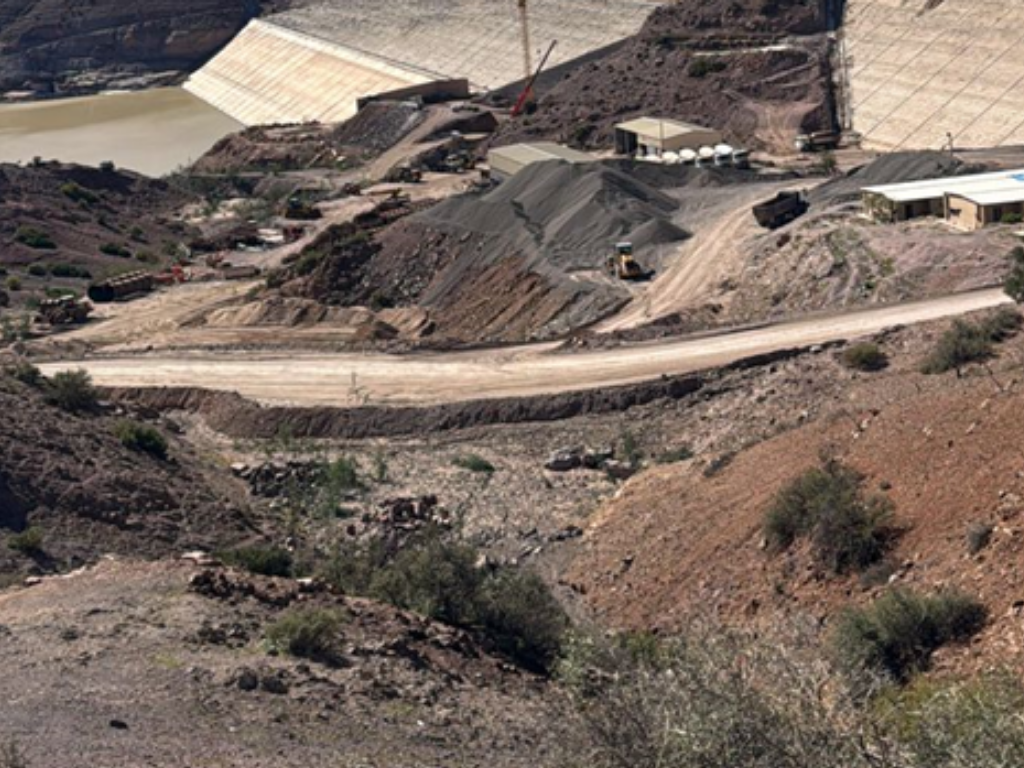
Image 3: Example of Souss-Massa's hydraulic infrastructure.
The trap nobody designed
There is a name for this in economics, and it is almost 160 years old. It is called the Jevons Paradox, and it goes like this: when you make the use of a resource more efficient, you often end up using more of it, not less (Borgomeo, 2026).
In Souss-Massa, the paradox is brutally elegant.
Drip irrigation made farming more profitable. More profitable farming attracted more investment. More investment paid for more boreholes, more hectares under cultivation, more pumps running for more hours. Every individual farmer made the rational, even admirable, decision to upgrade. Every individual hectare became more "water-efficient." And the aquifer — which doesn't care about litres-per-tomato, only about total litres out versus total litres in.
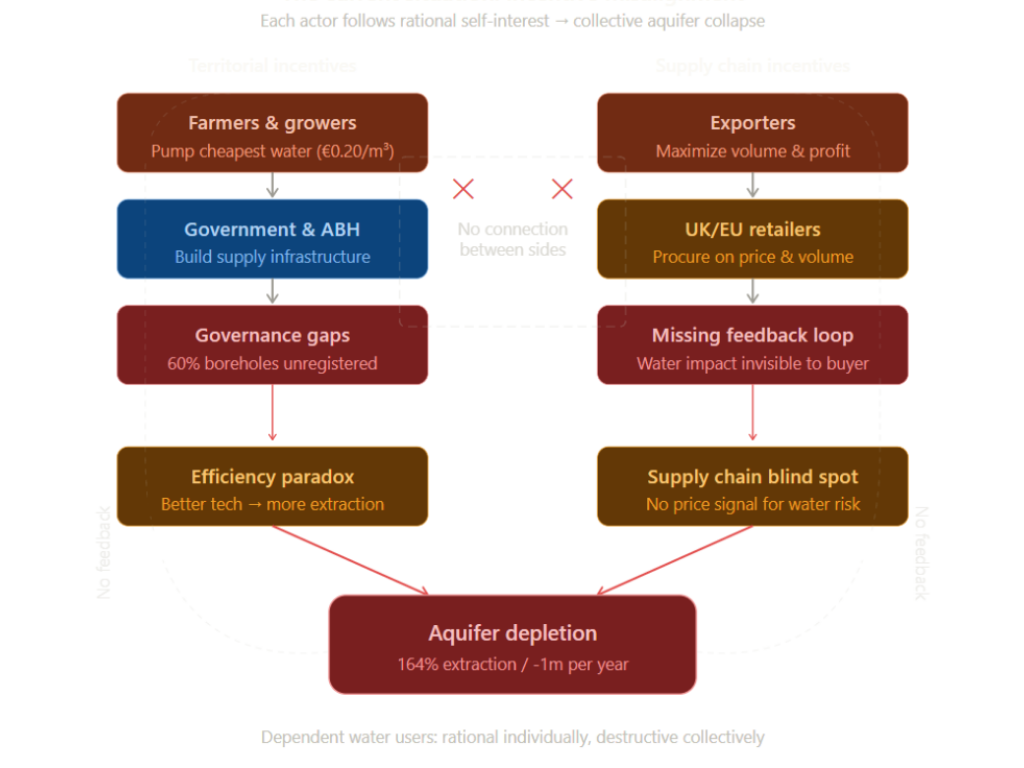
Nobody woke up one morning and decided to drain a basin. Moroccan farmers responded, rationally and legally and often heroically, to the incentives set in front of them: domestic agricultural policy, credit markets, trade agreements, and yes, the purchase orders flowing in from European supermarkets demanding consistent volumes of perfect fruit at predictable prices.
This is not a failure of technology. It is a failure of governance — and specifically, of the gap between two governing bodies not talking to each other.
On one side: territorial governance. Who is allowed to pump, how much, on what terms, under whose oversight. This lives in Morocco, in basin agencies, in ministries, in local agreements between farmers and the Kingdom.
On the other side: supply chain governance. Who buys, at what price, how to reward responsible water management. This lives in Europe, in retail headquarters, in certification bodies, in the procurement teams of companies lacking dialogue with Moroccan farmers.
These two systems shape the same drop of water. They have evolved almost entirely independently of each other.
Why you can't see it (and why that's the whole point)
Here is the cruellest part of the story: the impact is completely invisible at exactly the moments decisions get made.
The shopper in Edinburgh choosing between two punnets of berries cannot see the water table in the basin. The buyer in a London procurement office, optimising for shelf-life and price-per-kilo, has no live signal from the basin. Even the farmer, watching his own meter, has no way of seeing what 3,000 of his neighbours' meters add up to.
The feedback loop is broken. The hydrological reality of the basin and the economic reality of the supply chain are running on two different operating systems, and neither can read the other's files.
This is what makes "fair water footprints" not a slogan but a structural question. How do we make the basin legible to the people whose money ultimately moves the pumps? How do we turn a remote aquifer into something that shows up — meaningfully — on a buyer's dashboard, a retailer's risk register, a consumer's conscience?
From dependent users to co-stewards
I want to end not with a finger pointed at anyone, because the truth is there is no villain here.
There is a farmer trying to send his daughter to university. There is a basin agency outgunned and underfunded. There is a retailer responding to a consumer who wants raspberries in February. There is a consumer who genuinely had no idea.
The question that matters is not who is to blame. The question is:
What would it take for each of us - farmer, agency, exporter, buyer, consumer - to stop being a dependent user of this basin's water, and start becoming a co-steward of its future?
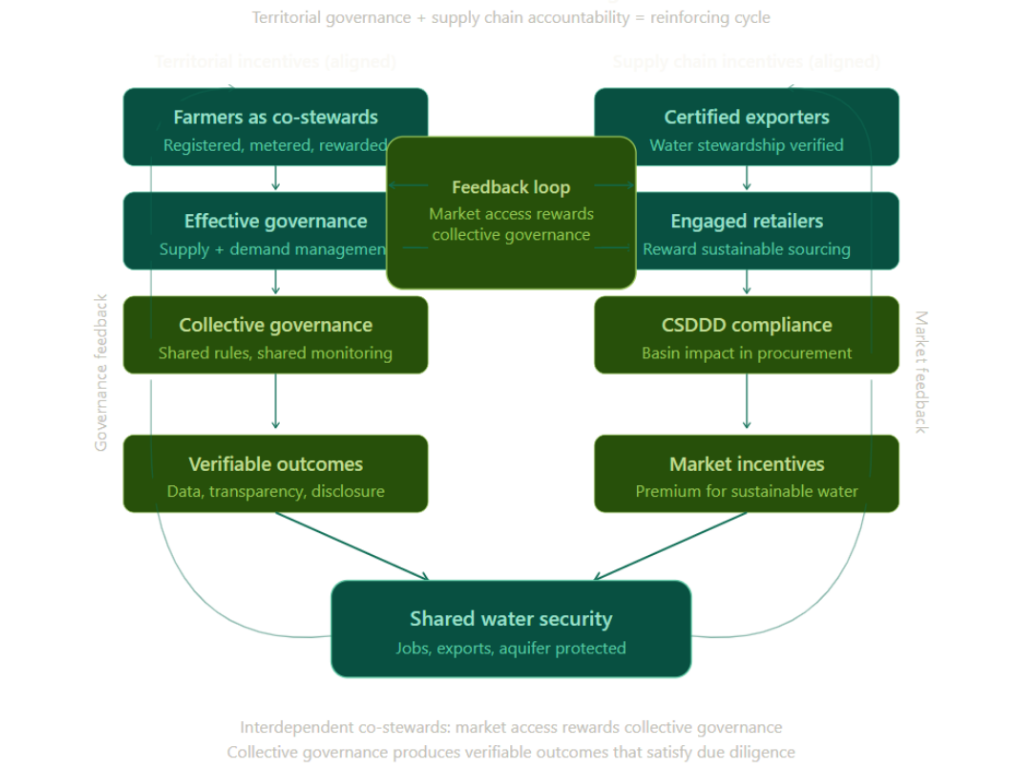
Co-stewardship is not charity. It is not certification theatre. It is the deliberate, patient construction of a feedback loop where the people who benefit from the water and the people who manage the water can finally see the same picture, in the same units, at the same time.
The transition needed is not just hydrological — it is structural. It means transforming farmers from dependent water users into co-managers of a shared asset: declared, metered, rewarded for collective stewardship.
It means connecting certified exporters and engaged distributors to basin outcomes through due diligence compliance obligations and market premiums for sustainable water sourcing.
And it means closing the missing loop — making governance verifiable, making basin health visible to supply chains, and making market access the reward for collective action rather than individual extraction. When territorial accountability and supply chain responsibility reinforce each other through this dual feedback, shared water security becomes real.
ENDS.
_____________
References:
Ezzine, H. (2018) Spatiotemporal monitoring of drought in Morocco and prospective assessment of its vulnerability in the context of climate change, based on open satellites short time-series.
Borgomeo, E. (2026) ‘The paradoxes holding back progress on water security’, Nature Water [Preprint], (1). Available at: https://doi.org/10.1038/s44221-026-00598-w
World Bank (2024) Water for Shared Prosperity. Available at: https://www.worldbank.org/en/publication/water-for-shared-prosperity